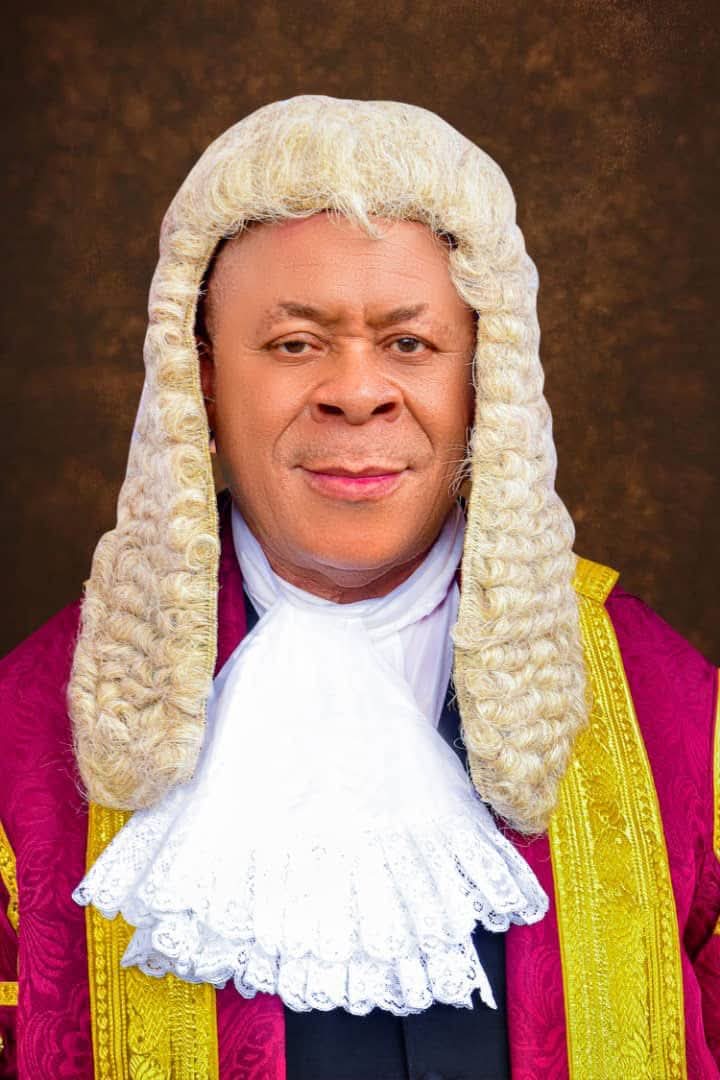
A decisive 4–1 judgment of the Supreme Court of Nigeria has conclusively resolved the dispute over the All Progressives Congress (APC) candidate for the 2026 Bwari Area Council Chairmanship Election, affirming the dissenting judgment of Justice Okon Abang which declared Hon. Joshua Ishaku the lawful flag bearer of the party.
Reading the lead judgment, Justice Jamilu Yammama Tukur set aside the majority decision of the Court of Appeal, Abuja Division, and affirmed the dissenting judgment earlier delivered by Justice Okon Abang, JCA.
The apex court held unequivocally that Ishaku’s suit was neither statute-barred nor premature and that the case did not fall within the insulated confines of internal party affairs.
The Supreme Court found that the lower court erred in its conclusion that the appellant’s action was caught by limitation.
It held that the “inevitable conclusion” from the record was that the appellant had been denied the opportunity to be heard and, therefore, denied fair hearing.
On the question of internal party remedies, the court made it clear that the internal affairs doctrine is not absolute.
Where party guidelines are violated or statutory and constitutional rights are implicated, particularly under Section 84(14) of the Electoral Act, the courts are not precluded from intervening.
In emphatic terms, the apex court stated that it is contradictory to insist that a declared winner of a primary election must exhaust internal dispute resolution mechanisms designed for aggrieved aspirants.
That obligation, the court clarified, rests on the losing aspirant. Each case, the court added, must be determined on its peculiar facts, and the lower court failed to properly evaluate the material evidence placed before it.
With the appeal allowed in its entirety, the Supreme Court set aside the majority judgment of the Court of Appeal, nullified its affirmation of Haruna Audi as candidate, and ordered the relevant authorities to publish Hon. Ishaku’s name as the APC candidate for the forthcoming council election. The decision is final and binding, bringing the litigation to an end.
The 96-page dissent now affirmed
The Supreme Court’s ruling gives full judicial endorsement to Justice Okon Abang’s 96-page dissenting judgment at the Court of Appeal delivered on 16 January 2026, a comprehensive opinion that meticulously examined the affidavit evidence and documentary exhibits in the case.
The dispute arose from the APC primary held on 25 June 2025, where Ishaku was declared winner with 33 votes.
The 2nd Respondent later challenged that outcome, asserting that a petition had been filed before the party’s Primary Election Appeal Committee, that the committee sat on 27 June 2025, that its report was ratified by the National Working Committee on 30 June, and that he was issued a certificate of return before his name was forwarded to INEC.
However, a central piece of evidence—Exhibit J—was an affidavit deposed to on oath by the 2nd Respondent in an earlier suit filed on 1st July 2025 concerning the same primary. In that deposition, he expressly acknowledged that Ishaku was declared winner and sought cancellation of the primary.
He made no reference to any petition, no claim that he had been declared winner with 38 votes, and no mention of any ratification by the National Working Committee.
Justice Abang considered those omissions significant. He held that Exhibit J, being a sworn deposition directly related to the same primary election and involving the same parties, was materially relevant in testing the consistency and credibility of the 2nd Respondent’s subsequent claims.
Accordingly, the failure of the trial court to evaluate that affidavit alongside the later documents, was described as a serious misdirection.
On the issue of limitation, Justice Abang rejected the argument that time began to run from the date of an alleged internal appeal committee decision.
A cause of action, he reasoned, could only arise when the appellant became aware that his name had been substituted and another forwarded to INEC.
Time could not run on the basis of a concealed or undisclosed internal act. The Supreme Court’s decision aligns with that reasoning in rejecting the statute-bar defence.
Justice Abang further held that a declared winner of a primary cannot logically be required to exhaust internal party remedies meant for aggrieved aspirants.
Where statutory provisions and constitutional rights are implicated, judicial intervention is warranted.
Finality and legal significance
By affirming the 96-page dissent and overturning the majority decision of the Court of Appeal, the Supreme Court has provided authoritative clarity on the limits of the internal affairs doctrine, the proper computation of time in pre-election disputes, and the duty of courts to rigorously evaluate affidavit evidence.
The apex court’s order directing the publication of Hon. Ishaku’s name settles the controversy with finality.
The judgment reinforces the principle that political party processes must conform to their own guidelines, statutory requirements, and the constitutional guarantee of fair hearing.