•Vision still alive – Agric commissioner assures
By Ernest Udoh-Robert/Emmanuel Ntekim
In this edition, WatchmanPost takes a look at how the coconut refinery set up by the Akwa Ibom State Government has failed to grow in this report written by Production editor Ernest Udoh-Robert and senior reporter Emmanuel Ntekim.
Background
Coconut was first mentioned in 545 A.D. by an Egyptian monk named Cosmos Indicopleustes. In his “Topographia Christiana”, Cosmos describes coconut as the “great nut of India”. In 1280, Marco Polo described coconut as growing in Sumatra, as well as in Madras and Malabar in India, calling it nuxindica, the Indian nut.
Regardless of its origin, coconut has spread across many tropics and coastal areas of the world. Globally, it is grown in 93 countries in 12.29 hectares, contributing immensely to the edible oil economy of the producing States.
In Nigeria
The first recorded coconut plantation in Nigeria was established in 1876 by the Roman Catholic Mission on Topo Island in Badagry, Lagos State. While smallholder cultivation existed earlier, this marked the beginning of organised, large-scale production, heavily concentrated in coastal regions like Lagos, Akwa Ibom, and Cross Rivers states.
The 1876 plantation on Topo Island was a key development centre, establishing coconut as a vital economic crop in the region. Other areas like Ikoyi in Lagos were historically known for coconut cultivation, sometimes referred to as Oko Alagbon (Coconut Plantation).
More than 90% of Nigeria’s coconut belt runs along the coast, with Lagos State historically holding the largest plantations, followed by Akwa Ibom, Cross River, and Bayelsa states.
For many years, the industry suffered from stagnant growth, aging trees, and lack of investment, leading to low productivity. To address a high import reliance (nearly 70% of domestic demand), Nigeria has launched major initiatives to boost local production, especially in Lagos.
Today, coconut is recognized as a significant “cash crop” in Nigeria, with growing investments in hybrid, high-yield varieties, and a sector valued at over $1 billion annually, with rapid increases in processing.
According to Rasak Musbau, who was an assistant director, public affairs, Lagos State Infrastructure Asset Management Agency, in his article entitled, “Lagos and the coconut connection”, published on September 2, 2020, about 300 products can be derived from coconut, and each can be a stand-alone industry on its own. Such is the multi-dimensional depth of the produce.
Coconut in Akwa Ibom State
The history of commercial coconut cultivation in Akwa Ibom State is a relatively recent, government-driven initiative aimed at diversifying the economy away from oil. Anchored by the St. Gabriel Coconut Oil Refinery, the project began in 2016-2017 to transform the state into an agricultural hub.
Former Governor Udom Emmanuel Administration launched the coconut initiative, formally incorporating St. Gabriel Coconut Plantation and Oil Refinery Ltd on June 3, 2016.
The plantation spans 11,000 hectares across three local government areas of Mkpat Enin, Eastern Obolo, Ikot Abasi, with Okobo as an additional yard. The government initiated the planting of over 2 million hybrid coconut seedlings, with a major planting drive occurring around 2022 to supply the refinery.
Refinery Construction: St. Gabriel Coconut Oil Refinery
The St. Gabriel Coconut Oil Refinery, designed for a 1-million-nut-daily capacity, was constructed by a Turkish firm, VKS. It was inaugurated in 2022 to process raw materials from the plantations. The initiative aims to position Akwa Ibom as a leading exporter of coconut oil in Nigeria. The below are facts of the St. Gabriel Coconut Oil Factory as was told by the former administration in the state:
1. St. Gabriel Coconut Oil Factory is owned by Akwa Ibom State Government.
2. The factory has the capacity to process 1,000,000 nuts, 300,000 per shift and 66 tons of oil in one single day.
3. St. Gabriel Coconut Oil Factory is expected to generate about 1,300 direct and more than 3,000 indirect jobs.
4. The multi-billion naira value-chain facility Coconut Oil Factory is located in the serene environment of Ikot Akpan Okop village, along the East-West Road in Mkpat Enin Local Government Area.
5. The groundbreaking ceremony of the coconut oil factory project was performed by Governor Udom Emmanuel on May 24th, 2017.
6. A 2million fast-yeilding hybrid coconut trees have been planted on an 11,000-hectare of land at the St Gabriel plantation, Mkpat Enin, Ikot Abasi and Eastern Obolo local government areas.
8. St Gabriel Plantation is the largest coconut plantation in Africa, and it is being complemented by other new coconut farms in Okobo, Eket and other parts of the State.
9. The St. Gabriel Coconut Oil Factory project was executed by a Turkish firm, VKS.
10. St. Gabriel Coconut Oil Factory is a conscious effort by former Governor Udom Emmanuel to prepare Akwa Ibom as Nigeria’s highest crude oil producing state from over reliance on petroleum.
Few years after the refinery/plantation
Communities hosting the St. Gabriel Coconut Oil Factory and the plantation are strongly placing a demand on the state government to urgently resuscitate the abandoned refinery and plantations in their communities or return their ancestral lands.
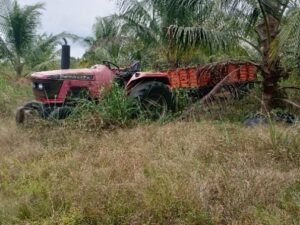
The land which was bequeathed to them by their forefathers and it was a free forest (Akai) for anyone to cultivate and feed their family. Equally, the economic trees there were the main source for any community project. And since most communities are riverine, and their source of protein which is fish, has been taken away from them by the government, it is painful seeing their source of livelihood wasting not of their own doing, but by powers bigger than them.
The state government, with the refinery and plantation had raised their hopes of a better and more meaningful life. But this hope was dashed by the reckless abandonment of the refinery and plantations by the same government.
The village head of Ikot Akpan Okop, Eteidung Obot Thompson, while speaking with WatchmanPost in his palace wondered, “How long do we continue to wait, tell me? Look at the coconut refinery that is sited in this village, of what benefit has it been to us? Apart from their security staff every other staff has been laid off, leaving the machines and equipment to rot away. The refinery is a monumental waste, and it has left our people who were doing menial jobs to return home to nothing.”
Eteidung Thompson recalled in 2016 when the then commissioner for Agriculture, Mr Iniobong Udoinyang came to him on the subject of land possession by the state government to be used for coconut refinery. He told the commissioner that he was not the appropriate person to discuss land matters with. It should rather be the commissioner for Lands and he would not attend to him. The village head advised the commissioner that when he gets to State Exco meeting he should tell them that he, the village head of Ikot Akpan Okop, says the agriculture ministry is not the proper ministry to discuss land matters.
“The commissioner was visibly angry and this brought issues between the state government and the community that culminated into my suspension as Eteidung for two and a half years”, the village head recalled.
Perhaps this may have informed the lack of extension of invitation to him for the ground breaking ceremony in 2017, which subsequently resulted in the lack of a representative to speak for the village at the ceremony.
Eteidung Thompson, while narrating further, said his suspension was lifted when the new Commissioner for Local Government and Chieftaincy Affairs, Mr Frank Archibong came into office. “Now when the then Commissioner of Agriculture came I asked, where would the government get raw materials for the refinery, he said, they were planting coconut. I advised them that coconut do well when they’re planted close to people and where they’re currently planted will not do well. But they did not listen, that’s why the coconuts they planted are not doing well”.
He emphasised the need for government to resuscitate the factory or return the land to the community who will put it to better use.
Paddling our way through the bumpy road that leads to the palace of Eteidung Sylvester Asuquo Akpan Inyang in Ikot Oyoro, Mkpat Enin Local Government Area, it was a clear sign that the village was in dire need of infrastructure.
The village head greeted us with a smile and offered us seats. And while we asked him about the coconut plantation, with a strong voice he said, “The former governor, Mr Udom Emmanuel, came to get land from Ikot Oyoro. Not Ikot Oyoro alone but took land from 13 villages in Ikpa Ibom clan.
“When they started the coconut project we were very happy. Though we had argued that they should take the disputed area between IkpaIbom and Okoroette. But they didn’t listen, but sited the plantation where it currently occupies. However, I won’t be able to tell you how many hectares of land government took for the coconut plantation, and since we are a group of people that appreciate good things we were very happy when the project came.
‘’The first project government brought to IkpaIbom Clan forest was the Model Science School, which government changed to a University. That change meant no more model secondary school there. Let me use this opportunity to call on government to replace the model school since the university has taken it. ‘’Before government possession of the land, our forest generated income for us and people cultivated the land for food. Part of the reasons we rejoiced over the coming of the plantation was because we were expecting compensation from government. We have struggled for them to pay us compensation to no avail. We went to court and got judgment in our favour for government to pay, but government appealed and the matter is still in court.
‘’Unfortunately, the coconut plantation is not doing well, because it is not being taken care of and sadly, workers have also been laid off.
“We were thinking that our present governor, Pastor Umo Eno, will do something about it since he promised to take development to rural areas, we are yet to see. Even the compensation we thought he will pay, nothing has happened. Now, if government is not ready to continue with the project let them leave so we could make use if the land”
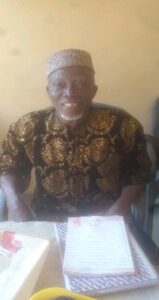
Eteidung Akpan Inyang of Ikot Oyoro village
At Ikot Akpaden, WatchmanPost met with the chairman of the village council, Elder Sunday Akrasi who also doubles as the village head representative. When asked about the allegation of black magic stunting the growth of the coconut by former governor Mr Udom Emmanuel, Elder Akrasi posited,”It is not true that witchcraft was used to stunt the growth of the coconut. We are not known to be diabolical.
‘’What we keep stressing is for government to pay compensation and do what they ought to do, perhaps things will change for good. I also want to use this opportunity to ask government not to abandon the project but if it is their decision to abandon the project, I believe the reasonable thing to do is for them to formerly hand over the land back to the communities.”

In Okobo
The government coconut plantation in Okobo Local Government Area is mostly located in Ekeya villages with smaller parts in Oti-Oro villages. The coconut occupied the entire seven villages of Ekeya Okobo namely: Obot Inwang Ekeya, Esuk Inwang Ekeya, Idib Enen Ekeya, Anua Ekeya, Ekpene Ekim Ekeya, Nung Ukana Ekeya and Ufok Esuk Ekeya.
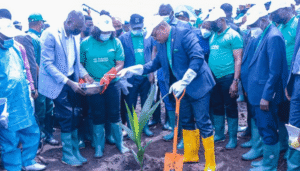
The Ekeya, Okobo plantation site was to serve as a complement to the main plantations located in Mkpat Enin, Eastern Obolo, and Ikot Abasi. It was later extended to Oti-Oro villages in Okobo. The former Governor Udom Emmanuel, who personally planted 50 seedlings at the Ekeya Okobo site on September 18, 2021, said the coconut which is of high yielding value in the international market, has the potentials to replace crude oil in the state.
The Okobo plantation is part of a broader, state government’s wide initiative aimed at cultivating two million coconut seedlings in the state for raw materials for the St. Gabriel’s Coconut Oil Factory at Mkpat-Enin.
During the planting exercise, the former governor directed trees to be cut down, mostly trees without economic values in Okobo schools, to replace them with coconut. “Each student in public schools will be given a coconut seedling to plant. In one day, one million students of secondary school would have planted one million coconut seedlings, which will create a competition amongst the youngsters. These are high-breed seedlings we’ve been able to acquire across the world. The refinery is going to be a master economic breakthrough”, said the former Governor in Okobo.
Workers and their stipends
After the flag off, over 70 workers from the seven villages Ekeya Okobo: Obot Inwang Ekeya, Esuk Inwang Ekeya, Idib Enen Ekeya, Anua Ekeya, Ekpene Ekim Ekeya, Nung Ukana Ekeya and Ufok Esuk Ekeya were used for the work. These workers were often paid a paltry sum of thirty thousand naira that was not regular. According to one of the staff members who worked on the plantation, Mr. Okon, said that, they usually received one month stipend after about three to four months might have passed. And that “they were often owed their monthly stipend”.
Also speaking to WatchmanPost reporter during the visit to the plantation farm, Mr. Offiong Offiong explained that large expanse of Ekeya community land is used for the plantation which was compulsorily acquired by the state government for the project without payment of compensation to the host communities.
He added that as a matter of fact, the community couldn’t ascertain the rightful owners of the plantation, whether government or private investor, since neither the duo effectively interacted with the community over compensation for the acquired land.
However, there are speculations that most of the lands were forcefully taken over by government from a private investor.
Why abandonment of the plantation in Okobo?
During site inspection in Okobo, WatchmanPost gathered that there were some key factors that led to the abandonment of the plantation. Hon. Tuka Eyo, former supervisor for chieftaincy affairs and councilor representing Ekeya ward, has these to say: “This was the last plantation in the series of the plantations that was done in the last administration. And this has been the most yielded of all the plantations. It was acquired through the Ministry of Agriculture. So, it’s the government that owns this place”.
“Now, as the compensation was not paid and the project abandoned, the community will have to think of what to do about their land. But for now, nobody is going there”, Eyo asserted.
Our reporters gathered that the large expanse of the plantation land was compulsorily acquired by the state government through the Ministry of Agriculture for the project without compensation being paid to the host communities, leading to resentment among the locals, especially within family lands that the plantation is sited.
Apart from the complaint of forceful acquisition of their land, the owners said they were not benefiting from the project; many were not employed or included in the project management team.
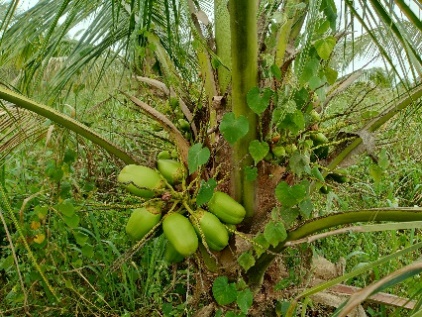
In Eastern Obolo, several of the imported hybrid coconut tree, intended to provide high yields for the refinery have remained stunted or failed to bear fruits years after planting in the region but that in the Okobo region of the site, bears fruits.
Also speaking Mr. Effiong Anso, a commercial motorcyclist who claimed one of the brothers had worked at the plantation, said “when Pastor Umo Eno became governor, the sacked worker complained bitterly, soliciting their payments.
“So, after much pressure, the information got to the Ministry of Agriculture and then to the state governor culminating into a one-off-payment by the government. Since then, the place was shutdown”.
He further said that the workers and contractors involved in the planting and maintenance of the plantations were not paid their allowances, resulting in the abandonment of the project sites.
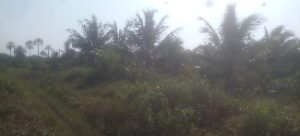
Our reporter saw that due to abandonment, some coconut trees planted in Okobo, suffered lack of maintenance, and lack of nurturing, while the plantation is overgrown with weeds.
An attempt was made to speak with the Village head of Obot Inwang, Chief Edet Etim, who also doubles as chairman, Ekeya Conference of Village Heads, but was not around during the WatchmanPost visit.
The now comatose St Gabriel Coconut Oil Factory inaugurated in 2022, has now made the host communities earnestly hope and pray for a messiah to come speak words of revival to the dead refinery. Just four years down the line, initiative that was widely celebrated with popm is unfortunately overgrown with weeds.
Though initiated on 24th May 2017 in a ground-breaking ceremony by the immediate past administration of Mr Udom Emmanuel, the project was expected to be completed in 2018 but dragged to 2022.
St. Gabriel Coconut Oil Factory Project, which the then government of the day descibed as a major industrial investment by Akwa Ibom State Government through the Ministry of Agriculture and Food Sufficiency, comprises of a factory complex complete with administrative offices, production areas, technical spaces, industrial firefighting systems, water treatment plants, effluent treatment plants and residential quarters for technical and managerial staff, as well as parking areas for tractors carrying raw materials.
The project is located in the serene environment of Ikot Akpan Okop village in Mkpat Enin Local Government Area on 7.88 hectares. The total construction area is 15,000 m2 to be built by a Turkish firm VKS Nigeria Construction Company. The factory was part of Udom’s industrialisation drive. It was billed to process over one million coconuts daily, featuring production areas, treatment plants, and staff quarters.
Meanwhile, to support it, government launched the planting of two million hybrid coconut trees across 11,000 hectares in several LGAs, touted as Africa’s largest coconut plantation, with the promise that the refinery would create 1,300 direct and 3,000 indirect jobs.
At its inauguration in 2022, the governor said it would boost the State’s foreign exchange base. Thousands of seedlings were earlier distributed to schools and organisations to ensure steady supply. But all that today seems like a lost dream.
And from WatchmanPost investigation, the refinery today is stalled and plantations failing. Obviously, the “signature” project of Udom’s industrialisation agenda has collapsed under the weight of poor planning, overriding community interest and lack of accountability. The project was designed to fail, and the huge investment pumped into it remains unaccounted for.