By UduakAbàsi Ikpat
There is a quiet but powerful culture in Nigeria’s South East that many parts of the country continue to admire and, increasingly, seek to emulate. It is the culture of enterprise embodied by the Igbo trader, the craftsman who begins with little but dreams big, the apprentice who learns the ropes in a crowded market and emerges years later to open his own shop. It is a culture that treats wealth creation not as a mysterious privilege but as a disciplined habit built on hard work, mentorship and courage. For decades, this entrepreneurial ethic has produced thousands of small and medium-scale businesses in Nigeria.
From the bustling markets of Onitsha and the city of Aba to commercial hubs in Lagos and beyond, the Igbo spirit of enterprise has proven that prosperity can be cultivated deliberately. Wealth, in that tradition, is not waited for, it is pursued with self determination and method.
It is this same spirit of industriousness, self-reliance and of a decisive structured empowerment that forward-looking leaders now seek to replicate within their domains. In Akwa Ibom State, Governor Umo Eno appears to be pushing a similar philosophy, one that aims not merely to distribute resources but to nurture an entrenched culture of wealth creation.
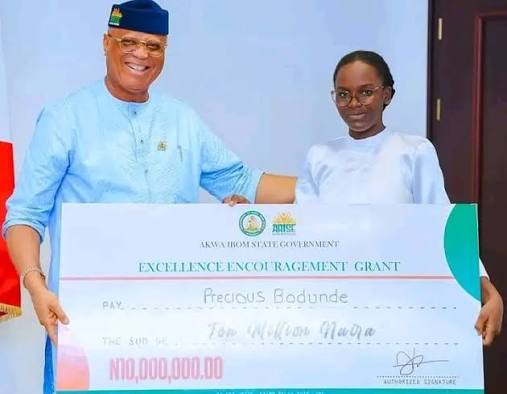
Recently, an example of this philosophy came from the grassroots. With the Executive Chairman of Urue Offong Uruko Local Government Area distributed ₦100 million to 100 beneficiaries, effectively creating one hundred new millionaires in one swoop. It was not merely a gesture of generosity, it was a statement about economic direction.
And if also replicated across the remaining thirty local government areas in the state, the implication would be striking.
The arithmetic shows that 3,100 citizens could receive similar significant financial empowerment. In a country where access to capital often determines the difference between ambition and stagnation, such economic intervention can alter economic destinies. But money alone does not create entrepreneurs. Capital without necessary skill or discipline can equally evaporate as quickly as it arrives.
That is why sustainable socio – economic empowerment must combine financial support with knowledge, mentorship and institutional backing. Governor Eno’s administration appears to recognize this delicate balance. And beyond symbolic gestures, the government has also initiated structures aimed at nurturing entrepreneurship and equipping citizens with the imperative tools required to thrive in a competitive economy.
One of such notable and remarkable initiatives is the Ibom Leadership and Entrepreneurial Development Programme, popularly known as Ibom LED. Conceived as a platform for developing entrepreneurs and business leaders, the programme is designed to expose participants to training, mentorship and practical strategies for building sustainable enterprises.
The significance of Ibom LED lies in its attempt to cultivate a mindset shift. Rather than waiting endlessly for government jobs that may never come, participants are encouraged to see opportunity where others see obstacles. They are seriously trained to build ventures, manage resources and moreover create value in their respective communities and the society at large.
Complementing this initiative is the Dakkadda Skills Acquisition Centre, which has become an important hub for vocational training and enterprise development. The centre reflects an understanding that robust economic transformation often begins with practical skills, carpentry, fashion design, ICT, fabrication and other trades that can quickly translate into income especially tech driven skills in such an era.
In Nigeria where the grappling with an alarming rate of youth unemployment is seen, such centres serve as incubators for self-reliance. They prepare young people not merely to seek employment but to create it. A trained artisan or digital professional can establish a small enterprise and, over time, employ others.
When viewed together, initiatives like the Ibom LED and Dakkadda Skills Acquisition Centre form part of a broader strategy to bring about poverty alleviation. And also represent an attempt to build ecosystem where ideas, skills and capital intersect to produce prosperity. Also, with the distribution of funds by local government leadership, therefore, becomes one component in a larger economic puzzle.
When beneficiaries of such significant empowerment programmes already possess skills or business ideas, the injected capital can ignite growth rather than temporary consumption. This is where leadership matters. Visionary governance is not measured only by the construction of roads or public buildings, necessary as those may be.
It is also measured by how effectively leaders enable citizens to become economically independent. Across Nigeria today, it’s undisputable the Igbo apprenticeship system has demonstrated that structured empowerment can produce remarkable outcomes. A young apprentice spends years learning under a master trader, absorbing not only the mechanics of business but also the discipline of such an enterprise.
At the end of training, the master settles the apprentice with capital to start his own venture. The result is a chain reaction of prosperity. One trader becomes two; two become four, and the cycle continues across generations. It is a model that has quietly over the years or decades produced thousands of millionaire entrepreneurs without any kind of government intervention.
Interestingly, Governor Umo Eno appears to be pursuing this too but in some ways, which is a public-sector adaptation of that economic philosophy. By investing in skills development, leadership training and sustainable financial empowerment, the administration seeks to stimulate a similar multiplier effect in Akwa Ibom.
If local government authorities align with this vision and replicate the kind of social intervention seen in Urue Offong Uruko, the economic landscape of the state could gradually shift. Communities that once depended heavily on public sector employment may begin to nurture various clusters of small businesses.
Of course, the success of such initiatives will ultimately depend on transparency, accountability and careful monitoring. Empowerment programmes must ensure that funds reach genuine entrepreneurs and that these training programmes remain practical rather than ceremonial.
Yet the broader idea deserves attention. In a nation often preoccupied with distributing wealth, the more enduring challenge is learning how to create it. The real test of leadership is whether policies can ignite enterprise among ordinary citizens. If the current momentum continues combining empowerment at the grassroots with initiatives like Ibom LED and the Dakkadda Skills Acquisition Centre, then what is unfolding in Akwa Ibom may well become a deliberate social experiment in wealth creation. In that unfolding story lies the deeper meaning of this moment, which is Governor Eno and the making of A’Ibom millionaires.