
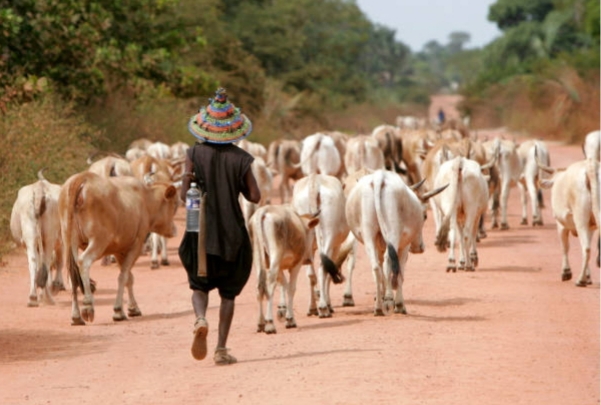
The present reality in Akwa Ibom State does not give credence to the existence of an anti-grazing law. Cattle roam freely along a number of major roads, schools, residential areas, littering streets with their dung, destroying farm crops, and disrupting traffic. What is more, the herders are at times seen armed with dangerous weapons and apparently enjoy the disruptions their animals cause. When clashes occur between herders and farmers, it is the farmers and the wider public who pay the high price, even though the guilty party us almost always the herders.
The implication of this reality is, therefore, that the implementation of the anti-grazing law in Akwa Ibom has become a joke. That became official during the governmemt-media parley of 29th May 2026 held at the Government House Banquet Hall. There, Brig. Gen. Koko Essien (retd), the Commissioner of Internal Security and Waterways, said that the law “is not against cows moving on the streets” and asked journalists to “go read the law.” He was not kidding as you might be tempted to think that he was!
If the man appointed by Governor Umo Eno in 2023 to oversee security in the state is a stranger to the basic intent and spirit of the law on cattle grazing in the state, then its implementation remains a farfetched dream. Come to think of it, the words “anti” and “open” are not ambiguous. They mean that cattle should not roam freely grazing in the open: highways, streets, or farmlands, but should be kept in secure enclosures like ranches. Is that too difficult for anybody, far less a retired army general, to understand?
Open grazing has been one of the major drivers of insecurity in Nigeria. To curtail it, many states, virtually all of those in the south of the country, began enacting laws to protect their citizens against nefarious activities perpetrated by armed pastoralists operating under the guise of herding, especially in the north central states of Benue.and Plateau. Their activities have led to loss of hundreds of lives, destruction of crops, and food insecurity. Many farmers in Akwa Ibom State have been victims of the negative activities of these herders. These farmers have lost valuable crops and money; some have come under physical threats by daredevil herders.
As the pioneer Commissioner of the newly-created Ministry of Internal Security, Essien is expected to spearhead the state’s security strategy, coordinate the security management team, promote private sector investment in agriculture, manage and where necessary, upgrade the state security architecture. But as shown at the press briefing, he has left many critical observers wondering if he is at home with a law he is meant to enforce. And the silence of the state government is not helping matters. Akwa Ibom deserves far more than this.
For a historical context, former Governor Udom Emmanuel assented to the Akwa Ibom State Anti-Open Grazing Prohibition and Ranches Establishment Bill on 15th September 2021. He declared that the law was “no respecter of persons, irrespective of status.” With that assent, Akwa Ibom joined Rivers, Bayelsa, Oyo, Ekiti, Abia, Lagos, and Enugu as the eighth southern state to enact anti-open grazing legislation.
While signing the bill, Udom Emmanuel instructed relevant authorities to ensure the law was implemented and enforced to the letter, with strict compliance and culprits brought to book. Yet, nearly five years later, that directive remains on paper. No herder known to us has been prosecuted for grazing on the Banking Layout off Udo Udoma Avenue, for occupying the field that houses the amphitheatre and other government facilities, or for destroying farmlands. Cattle move with audacity, unhindered, while the government law is eternally on the lyre singing lullaby to the law to sleep.
The incessant pastoralist-farmer crises in post-colonial Nigeria are linked to the non-enforceability of the law against open grazing. Scholars have pointed to a tripartite nexus between law, class, and economic structure in the post-colonial state to explain why herder-farmer conflict persists despite anti-open grazing regulations.
The Nigerian state and its political economy remain skewed in favour of the ruling class. That class, which controls state institutions including law enforcement, leverages its privilege to implement laws that advance its interests. When sub-national governments enact legislation deemed to undermine those interests, the centre often relies on control of federal security institutions to weaken enforcement. Any attempt to resolve herder-farmer conflict through law alone will, therefore, yield minimal outcomes without broader political reform.
This tension is evident at the federal level. Law enforcement agencies have displayed crass reluctance in arresting and prosecuting violators of anti-grazing laws. Part of the reason is the 2021 declaration by the then Minister of Justice and Attorney General that state anti-grazing laws were “illegal” because they allegedly infringed on herders’ constitutional right to freedom of movement and on ECOWAS protocols. He was simply hiding his ethnicist bigotry behind the veneer of legal hypocrisy blinded to the bloodlettingand criminality of killer herders. Here is the point:
That position contradicts the subsisting order of the Federal High Court, Abuja Division, which upheld the validity of such legislation. In a ruling on Benue State’s anti-open grazing law on 20th May 2021, Justice Ijeoma Ojukwu affirmed the legality of the Open Grazing Prohibition and Ranching Establishment Law 2017. She stated that it is the basic responsibility of every government, national or sub-national, to protect its citizens wherever they may be, and that governments incapable of doing so should exit office.
Given the foregoing, Akwa Ibom faces a stark choice: enforce the law or take it off the books. A law that exists only in the gazette but not on the streets breeds contempt for all laws and erodes public trust in government. The state government’s deafening silence on the statement by its Internal Security lead officer is ignoble and tells the public that someone or some interest is uncomfortable with the law. The goverment must come clean on this. Accordingly, the state attorney general and justice Commissioner should issue a clear legal opinion aligning with the Federal High Court judgment. Leadership without clarity is confusion.
We call on the state security management team, in collaboration with the police, civil defence, and community vigilance groups, to take a closer look at the law and enforce it to the letter. Ranching incentives should be provided to herders willing to comply, while those who insist on open grazing, under which guise something sinister may be going on as it has been the case in some other states, must face the consequences.
It is our position that open grazing is not a cultural debate; it is a security and economic issue. Until the Akwa Ibom State Government decides whether its anti-grazing law is meant to be obeyed or not, cows will continue to dictate the movement terms on our roads and farms. The security and welfare of our people must have priority over the economic interests of a few elite who own the cattle, or the angst of being politically correct. If the state government cannot defend our homeland then it has overstayed its welcome.
A government that cannot protect its farmlands cannot guarantee food security. A law that is not enforced is worse than no law at all. It is time for Akwa Ibom to lift the opaqueness and ambivalence over this law. It has a choice: either enforce it, or repeal it and face the consequences honestly.